
WHERE DOES MOSS COME FROM — NEAT PLACES ON EARTH

In celebration of Earth Month, I’d like to highlight a question I’ve been asked from time to time throughout the ten years of designing preserved moss walls: Where does moss come from?
Sourcing ethically harvested, preserved mosses that we use in both residential and commercial forest art has been a guiding principle of Forage + Design from the beginning, and I was reminded of the many neat places on Earth that these beautiful mosses come from.
Read on to learn more about the journey of preserved mosses, from forests to Forest Art.

how mosses like reindeer lichen are "farmed"
Outside Oslo Norway, a landscape opens into something untamed and rugged. Dappled pine forests sit, sheltering carpets of scattered needles and patches of white lichen thriving where not much else can. Here, soft cushions of reindeer lichen grow, glowing white against the darker rock and treed background.
Reindeer lichen has been harvested commercially for 60 years, and this is where the farms we source our reindeer lichen come from. Harvesting is a short season, running from early spring through to early fall, or as the weather allows.
The land is not restricted by fencing, and wildlife grazes freely across the fields and forests. The moss is “farmed” using practices that allow for sustainable regeneration. Some of the moss is collected through permits on Crown land, through conversations with private landowners, and in coordination with local forestry industry before trees are harvested.

Sustainability is of utmost importance to protect natural cycles by gathering carefully, then allowing the area to rest. Harvesters walk through lightly treed pine and rocky forests, taking only 5–10% from an area so as not to remove more than the land can give, allowing for natural regeneration. Bits of debris naturally fall away during moss picking, helping to propagate the land once more. Harvest areas are rotated every 20 years and are within a 20 km radius. These are natural forests, and as such, no fertilizers or irrigation are applied to the moss.
Because of the natural cycles of nature, some years there is abundance, and some years there are leaner pickings. In harsher years, the biting cold or bugs can damage the moss, requiring time for it to grow back.
A Few Of Our Favourite Mosses And Where They Come From
Norway
Reindeer lichen is a sponge-like organism sourced from Norway. This coral-shaped lichen is technically not a plant but rather a combination of a fungus and algae. It grows in dense cushion-like mats on the ground and can vary in colour, mostly white with some grey or greenish shades. Thriving in poor nutrient soil, reindeer lichen gets its name from its relationship to, you guessed it, reindeer! It is the primary winter food source for reindeer and caribou.
When it is humid, reindeer lichen can hold up to 3–5 times its dry weight. When the moss is preserved, salt is added to the process along with glycerine. The salt is trapped in the moss during the preserving process and help giving it a more solid structure; otherwise, the moss can be too soft to even work with. In dry climates like Alberta, the humidity leaves the moss during winter, creating a brittle and easily breakable structure. This is why we condition this moss with our glycerine spray to maintain softness, and it re-stabilizes when humidity returns in the spring and summer months. If salts are not included along with the glycerine, the reindeer lichen loses its form and structure.

Personally, I love using reindeer lichen in moss wall logo work, particularly as it comes in an incredible spectrum of dyed colours! A recent project was for our client, Mach Six Change, shown below.


France, Italy, Spain
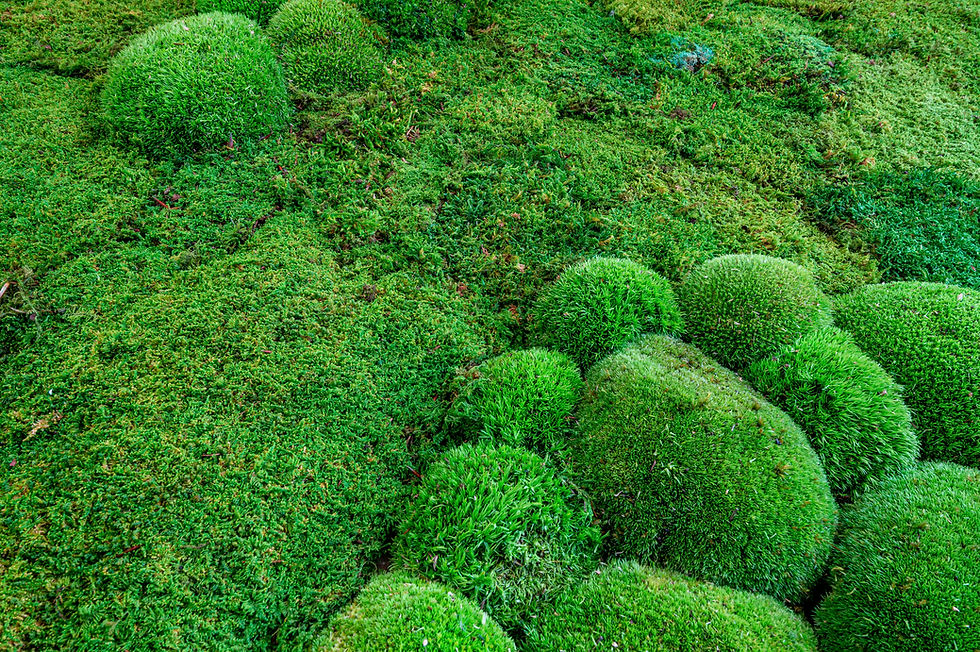
Pole moss is derived from France, Italy, and Spain. It's a clumping, sponge-like moss that retains moisture, kind of like a water-holding tank. Typically, pole moss takes 3–5 years to grow until it is ready for harvest.
It is grown in very specific conditions that need sandy-like soil with good drainage, typically found under pine trees. During harvest, the moss is collected, and bits from the moss are left behind as it is pulled, allowing the land to reclaim them for propagation.

France & Canada
Sheet moss is a fast-growing moss that takes only 1–2 years until it is ready for harvest from France + Canada and prefers to grow on moist rocks in low light. It likes to spread out rather than grow in upright clumps like other species.
Because of its fast-growing cycle, we can harvest 50–60% in a space to allow it to regrow with vigour.
France
Mood moss and fern moss grow in lush, thick carpets in France and are a favourite in our moss wall designs. These preserved mosses can be found in many of our walls including our beauty Millennium Tower installation. These mosses come to us in a couple of different forms, even though they grow in similar patterns. Mood moss is harvested by gathering palm-sized clumps rather than larger sheets like fern moss is, which is neat!

Let's Celebrate Earth MONTH!
As Earth Month is upon us, we are reminded of this precious and beautiful home we call Earth. With sustainability as a core value of Forage + Design, transparency and education on where we source our moss is important to us.
We choose our moss suppliers like By Nature Design who work hand in hand with European and Canadian farmers who follow the best sustainably harvested practices, ones that honour the biodiversity of the land they come from. Local harvest workers are paid living wages, and the land is carefully managed to allow for regulation and the regeneration of healthy forests.


Hi, I'm Heidi!
Each Forest Art creation is designed and crafted by our Chief Designer: Heidi Bekker.
Heidi is passionate about creating art that inspires wonder in our natural world, including the featured "Heart of The Forest" Millennium Tower commercial design featured in this blog.
Learn more about Forage + Design's commercial and residential moss wall services here.
Did the part about moss in Alberta's winter conditions catch your eye? Learn more about how we maintain our preserved moss walls amid low humidity conditions in our blog here.


Comments